
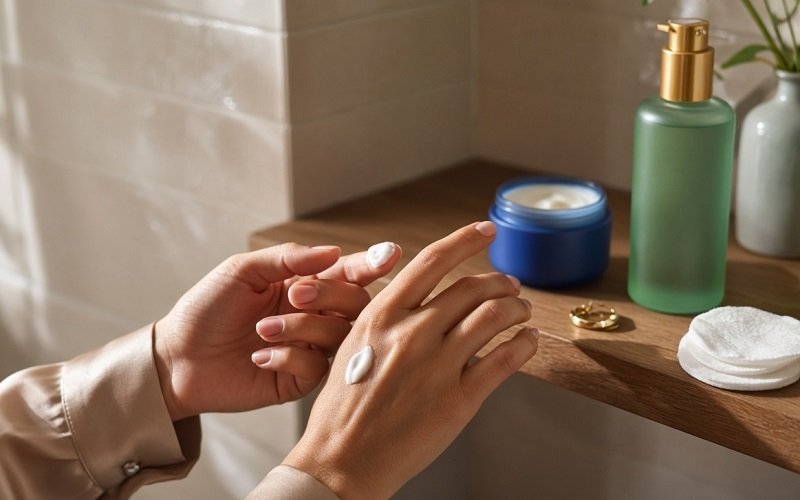
A practical first-routine guide for anyone who cares how their skin looks under makeup, office lighting, and everyday clothes — without building a 12-step shelf.
If you have ever stood in a drugstore aisle holding a blue tin in one hand and a green bottle in the other, you already know the feeling. Skincare looks simple until you have to buy something. Then every label promises glow and a version of you that apparently already owns a fridge full of serums.
Most beginners do not need a brand identity. They need three jobs done well: clean the face without stripping it, put moisture back, and protect it from the sun. Nivea and Garnier both can do those jobs. They just do them with different personalities.
Think of it the way you think about a first wardrobe. You do not need a designer closet. You need pieces that fit, that you will actually wear, and that do not fight each other.
The short answer, before the nuance
Yes — Nivea is a good starting brand for most complete beginners, especially if your skin feels dry, tight, reactive, or you simply want a routine you can keep on a bathroom shelf the size of a paperback.
Garnier is also a good starting brand if your main complaint is oil, shine, leftover makeup, dullness, or clogged-looking pores, and you prefer lighter textures that disappear under a shirt collar or foundation.
Neither brand is “better” in the abstract. Loyalty is a marketing habit. Fit is a skin habit.
What each brand is actually selling you
Nivea: comfort first
Nivea built its reputation on moisture. The classic Creme in the blue tin, Nivea Soft, the Q10 face creams, the hand and body lotions — the through-line is comfort. Formulas often lean on glycerin, panthenol, shea butter, and richer textures that sit on the skin like a cardigan rather than a silk camisole. That richness is the point and the limit. On dry skin it feels like relief. On very oily skin, some thicker creams can feel like a winter coat in July.
The brand is not stuck in 1911. There are lighter face lotions, fragrance-free sensitive options, and SPF day creams. The mood is still: protect the barrier, keep things simple. If fashion is your world, Nivea is the well-cut basic. Unshowy. Repeatable. Easy to live in.
Garnier: a job for every concern
Garnier talks more like a modern beauty counter. Micellar waters, vitamin C brightening lines, niacinamide, hyaluronic acid, charcoal, salicylic acid — the shelves are organized around problems. Dull? There is a bottle. Oily T-zone? There is another bottle. Makeup that refuses to come off after a long day? Micellar water was practically built for that.
The SkinActive Micellar Cleansing Water is the product most beginners should actually care about. It lifts everyday makeup, sunscreen, and city grime with a cotton pad and no rinse. Some versions add a vitamin C derivative; treat that as a nice extra, not a miracle. A wipe-off cleanser does not sit on skin long enough to behave like a serum. Garnier’s strength is choice. Its risk, for a beginner, is also choice.
A fair comparison, without the scoreboard energy
| If you care about… | Nivea tends to win | Garnier tends to win |
|---|---|---|
| Dry or tight skin | Richer creams and lotions that last | Hydration exists, but textures run lighter |
| Oily or shiny skin | Works if you pick lighter formulas | More gel-cream and oil-control options |
| Sensitive beginners | Simpler formulas, sensitive ranges | Fine if you avoid heavy fragrance and strong actives |
| Cleansing / makeup | Decent basic washes | Micellar water is the standout |
| Price & mental load | Affordable; easier to shop without overthinking | Affordable; more decision fatigue on the shelf |
Read that table as a map, not a ranking. A lightweight Nivea face lotion can beat a heavy Garnier cream on oily skin. A rich Garnier night cream can beat a thin Nivea gel on dry winter skin. The bottle in your hand matters more than the logo on the cap.
How this shows up in real life (not just on a bathroom sink)
On a fashion-minded site, it is fair to say skin is part of the outfit. Foundation sits differently on a dehydrated face than on a comfortable one. A high neckline photographs every flake. Office air-conditioning turns a thin routine into tightness by mid-afternoon. Night makeup looks muddy if last night’s cleanser left a film — or if this morning’s cream was too rich for your T-zone.
Match texture to climate the way you match fabric weight to weather. A rich cream under a wool coat in January can be a gift. The same cream under a silk blouse in August can look like shine you did not style on purpose.
Build a three-piece “face wardrobe,” then stop
Ignore the 10-step videos for now. A beginner routine has three pieces, the same way a weekday outfit has trousers, a top, and shoes.
Morning: water or a gentle cleanser if you wake up oily, then moisturizer, then sunscreen. Sunscreen matters more than any vitamin C serum on a For You page. If the moisturizer does not include enough SPF, add a separate one. Makeup goes on after that.
Night: cleanse properly. If you wore makeup or SPF, Garnier micellar water on a pad is an easy first pass. Follow with a gentle wash if your skin can take two steps, or stop at micellar if you strip easily. Then moisturize. Give this skeleton two to four weeks before you add a serum.
Which brand to start with, by the skin you actually have
Dry, tight, or winter-chapped: start with Nivea. Pick Nivea Soft or a face cream labeled for dry or sensitive skin rather than the thickest tin out of nostalgia. You want comfort that does not transfer onto a shirt collar.
Oily, combination, or makeup-heavy days: start with Garnier for cleansing. Micellar water plus a light moisturizer usually wears better under concealer. If your cheeks are dry and your T-zone is shiny — very common — mix. Garnier to clean, a lighter Nivea lotion only where you feel tight.
Sensitive or “I react to everything”: fewer ingredients, fewer new products at once. Nivea’s simpler and fragrance-free sensitive options are often the calmer first bet. Patch test on the jaw. Stinging or a rash is a stop sign, not a “purge.”
Breakouts and congestion: Garnier has more products aimed at oil and blemishes. That is not permission to start with a full acid routine. Cleanse gently, moisturize lightly, then add one targeted product later — not five because the display said “acne kit.”
Can you mix Nivea and Garnier?
Yes. In fact, mixing is often smarter than picking a team. A common drugstore pairing that works for a lot of people: Garnier micellar water at night, a simple Nivea moisturizer after, and a dedicated sunscreen in the morning from whichever brand (or a third brand) sits well under makeup.
Skin does not read logos. It reads texture, fragrance load, and whether you were gentle.
The mistakes that make either brand fail
- Buying a whole line because the campaign looked cohesive. You need functions, not a matching set.
- Scrubbing as if dirt is a stain. Harder washing does not clean better. It just leaves the barrier angry.
- Skipping sunscreen because the moisturizer “feels protective.” Feeling is not SPF.
- Adding vitamin C, acids, and a clay mask in week one. Beginners confuse activity with progress.
- Switching products every time a reel promises glass skin. Consistency beats novelty.
- Using a rich body cream as a face cream just because the tin is familiar. Face and body formulas are not always interchangeable.
What I would put in the basket on a first trip
Unsure of your skin? Start with a mild cleanser you tolerate, one everyday face moisturizer, and a separate sunscreen. If you wear makeup, swap the night cleanse for Garnier micellar water and keep the moisturizer light. Nivea often wins on cost-per-use because the tubs last. Garnier can creep up in spend if you keep adding “one more concern” bottle.
So… is Nivea a good starting brand compared to Garnier?
For a true beginner who wants fewer decisions and more comfort, Nivea is the easier on-ramp. It will not dazzle you with a 12-ingredient story. It will, in most cases, leave your face less tight than it was yesterday.
Garnier is the better on-ramp if your problem is oil, dullness, or makeup that needs a proper exit at night. Remember one line: start with the simplest routine your skin will actually keep. Brand is a shopping shortcut. Skin type, texture, and patience are the product.
The takeaway
Nivea is a good starting brand compared with Garnier when you want simplicity and moisture. Garnier is a good starting brand compared with Nivea when you want lighter textures and a clearer answer to oil, makeup, or dullness. Most people, if they are honest, will eventually own something from both — the same way a working wardrobe eventually includes both a sturdy coat and a breathable shirt.
Start small. Watch the mirror in daylight, not just under bathroom bulbs. Give products time. That is how beginners stop shopping and start having skin they can live in.